This by-election in Wales could be the beginning of the end of Starmer’s premiership. Reform stands to benefit from the disillusionment with the Government in Caerphilly
Keir Starmer is having a torrid time; crisis after crisis, scandal after scandal, with no sign of any pain relief ahead. In fact, it’s probably going to get worse before it gets better when, next month, a little-noticed by-election in south Wales could spark his next political storm.
Mighty oaks from little acorns grow, as the saying goes, and the acorn in question is my hometown of Caerphilly. Like much of Wales, it has voted Labour for more than a century. It has elected a Labour MP in every general election since the 1910s, and a Labour Member of the Welsh Parliament in every devolved election since 1999.
A defeat would be disastrous for morale, but worse, it would start a ticking time bomb ahead of the wider Welsh elections in May next year. If Labour were to lose those elections, Starmer would become the first leader in more than a century to lose the Welsh electorate. The backlash would be fierce and could well bring his premiership to an end.
Quite the mighty oak. Conservatives are few and far between in Wales, but I was one of them. I was born and raised in Caerphilly, began my career there, and later worked in Downing Street for Rishi Sunak, making me something of an anomaly.
Caerphilly is a former mining town just outside Cardiff, best known for its cheese and as the birthplace of comedian Tommy Cooper. It also boasts one of the largest castles in the UK, complete with a leaning tower that rivals anything in Italy; and in 1913, nearby Senghenydd suffered the worst mining disaster in British history when an explosion killed 439 miners.
On the more notorious side, Caerphilly is also home to Lansbury Park – the council estate where I went to primary school – which has long been ranked among the most deprived communities in Wales, and indeed the UK.
For me, politics was personal. I grew up surrounded by Labour’s failures. Most of the local councils and the Welsh Parliament have been Labour-run since their creation, and from what I saw, they did little to improve the lives of people around me.
If anything, standards were going backwards. The lowest educational standards in the UK, one of the slowest-growing economies, persistently high unemployment, why would anyone continue voting for the very people responsible? I could never quite understand it.
Politics was rarely discussed in my family. But as my interest grew, I remember asking my nan about her views. “I’ll vote Labour, love, always have and always will.” When I pressed her on why, she simply explained, “That’s how it is around here. My father voted Labour, so I always have.”
That small exchange reflected a wider political reality in Caerphilly. It had become a no-man’s-land for other parties, a place that didn’t need attention or receive attention because the result was always the same. For much of my life, it felt impossible to change the Welsh political tide.
That changed in 2016, when the EU referendum came along. Caerphilly – along with much of Wales – went against Labour and voted to leave, 57 per cent against 43 per cent. To me, it was no surprise. To Westminster, it was incomprehensible.
Fast forward to today, and Caerphilly looks more likely than ever to vote against the tide again. The by-election follows the tragic and premature passing of Labour Senedd member Hefin David. Still a young man and respected across party lines, his death came as a huge shock to everyone who knew him in Cardiff Bay.
His absence opens a political contest that could reshape Welsh politics ahead of the May elections and determine Starmer’s fate. Poll after poll in Wales over the past year has set the stage for a Wales-wide battle between Plaid Cymru and Reform, something that was until very recently unthinkable in the breeding ground of Nye Bevan and Neil Kinnock.
Plaid Cymru’s position isn’t straightforward. They are not blameless in Wales’s problems, having repeatedly propped up Labour governments in Cardiff Bay. And unlike in Scotland, nationalist parties in Wales have never broken through en masse, held back by strong patriotic UK traditions: pride in the military, pride in the Royal family, and pride in being British.
Reform is poised to benefit from this pride, and from the “they can’t be any worse” vote, just as it is on the national stage. But it is also well-placed to appeal to Wales’s underlying socially conservative instincts.
Caerphilly, like the rest of the Welsh valleys, is deeply socially conservative, an unusual reality for what has long been the heart of Labour’s stronghold in south Wales. Like many northern towns, it has been left behind by a Westminster that seemed distant and out of touch.
Boris Johnson was always surprisingly popular across Wales, but his appeal was limited by the legacy of Margaret Thatcher and the mine closures of the 1980s. Farage carries no such baggage. In Caerphilly’s streets, many will see him as a straight-talking, no-nonsense opportunity for change. He knows it too.
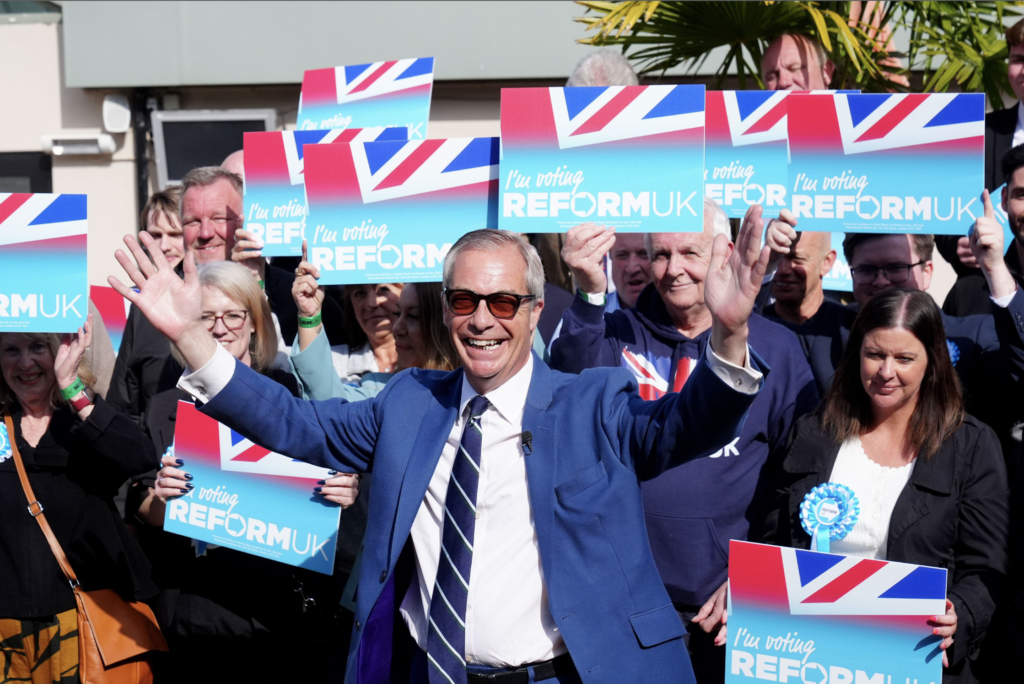
If you were watching the news last week, you would have seen him there in Caerphilly town centre, laughing, joking, and promoting the Reform UK candidate for the poll on October 23. Starmer will surely have to campaign there, even if some local candidates are reluctant to host him.
Caerphilly has long been a brick cemented firmly into Labour’s red wall, but walls don’t collapse all at once; they fall piece by piece. If Caerphilly slips, it won’t just be another by-election defeat, it will be the first sign that the foundations of Labour’s dominance in Wales are giving way. And once one brick goes, others soon follow.

 Opinion